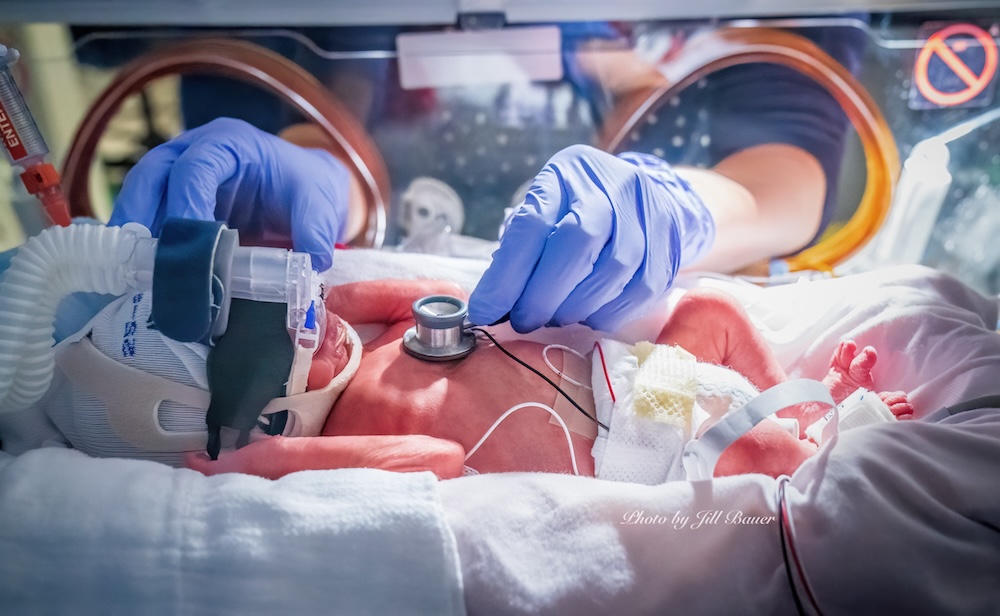
Hundreds of times each day, in hospitals and communities around the world, newly born infants become ill and require specialized care. Each member of the health care team—nurses, physicians, therapists and assistants—must know what to do for the sick infant. Their care must be provided in a timely, efficient, anticipatory, and effective manner. This early transitional care affects not only the immediate health of the infant, but also the infant’s long-term outcome. The S.T.A.B.L.E. Program was developed to meet the educational needs of health care providers who must deliver this important stabilization care. S.T.A.B.L.E. education is critical to the mission to reduce infant mortality and morbidity and to improve the future health of children and their families.
S.T.A.B.L.E. is the most widely distributed and implemented neonatal education program to focus exclusively on the post-resuscitation/pre-transport stabilization care of sick infants. Based on a mnemonic to optimize learning, retention and recall of information, S.T.A.B.L.E. stands for the six assessment and care modules in the program: Sugar, Temperature, Airway, Blood pressure, Lab work, and Emotional support. A seventh module, Quality Improvement stresses the professional responsibility of improving and evaluating care provided to sick infants.
First introduced in 1996 in the US and Canada, S.T.A.B.L.E. has grown internationally to include instructor training and courses in more than 45 countries. Currently, there are more than 3,400 registered instructors worldwide and more than 201,000 neonatal healthcare providers have completed a S.T.A.B.L.E. Learner course.
Student Participation Statistics
Students who complete the S.T.A.B.L.E. Learner Course are awarded a course completion card. We track the number of students who earn a card by credential. These statistics are updated quarterly. Click here to download the Learner Participant and Credential Stats.
Who should participate in a S.T.A.B.L.E. Learner course? More information...
Program Instructors
"I taught the STABLE Program in Kigali, Rwanda in east central Africa this past October at King Faisal Hospital. I had 22 students who were NICU nurses, residents, ICU nurses, midwives, and ER nurses. It was a very humbling experience to find students who were so utterly engaged in the class and so eager to learn! And how rewarding it was to be a part of bringing STABLE to healthcare providers in another country! I will be ..."
- Sherri Brown, RN
BSN, RNC-NIC
The University of Kansas Hospital
Kansas City, Kansas
Read More